

History of Christ Episcopal Church
Our History
History of Christ Episcopal Church condensed and edited from the historical documents of the parish and a historical summary written by Alda Thompson Furches – September 1982
The community of Christ Episcopal Church, Rowan County, can trace its history back to colonial times, and was organized by the Legislature of the Province of North Carolina Colony in 1754. It was the last parish of the Church of England organized in the colony by the efforts of the Society for the Propagation of the Gospel (S.P.G.). Various priests supplied services in the area on an irregular basis before the Revolutionary War, but none remained more than two years, nor did they live in the area.
After the Revolutionary War, a number of families from Saint Mary’s County, Maryland settled around Young’s Mountain, and built a log church building near the spot where the present church building stands now (near a fresh water spring). The log church burned in the 1890s, but its two cemeteries, near the present building, are still in use. Some of the earliest graves are marked only with fieldstones. The earliest dated burials are in the 1780s.

The first permanent minister of the parish, after the Pre-Revolutionary efforts of the S.P.G. was the Rev. Robert Johnstone Miller. He took charge of the parish and moved to what is now Cleveland in 1786. In addition to having charge of Christ Church, he also served other Anglican missions in the area, including Ft. Dobbs, St. Luke’s (Salisbury), and others; some at great distances. He was present at the Tarboro Convention of 1794, which attempted (but failed) to organize an Episcopal diocese in the state of North Carolina. Despite the difficulties of the pioneer Churchmen of this area, most of them remained faithful to the Established Church and this fidelity ultimately resulted in the re-organization of the congregation and its admission into the newly organized Diocese of North Carolina at its convention in Raleigh in April of 1821. Mr. Almand Hall was the first delegate from the congregation of Christ Episcopal Church seated at the convention. The Rev. Miller was the only person present at both the Tarboro Convention of 1794, and the convention in 1823, which elected the Rev. John Stark Ravenscroft first bishop of the Diocese of North Carolina.
The deed for the 4.5 acres of land on which the current building stands is dated February 15, 1822. At the time of its admission to the Diocese of North Carolina, Christ Episcopal Church was the second largest parish in the diocese, and the congregation started building a new building in 1823.

The timbers were hewn out by hand and all exposed parts were planed down to a smooth surface by hand. The original church building had a large gallery that was used antebellum for the considerable number of slaves who attended services. Though it has been enclosed, remnants of the gallery still remain. The marks of the axe used in hewing can still be seen in the pillars supporting the gallery. Bishop Ravenscroft consecrated the current church building on July 29, 1827.

The Rev. Thomas F. Davis was called by the congregation to be rector in 1836. Under the influence of the “Oxford” or “Tractarian” Movement, he instituted the Holy Eucharist as the principal service on Sunday in 1837. This practice continued until the 1890s. The Rev. Davis left Christ Episcopal Church in 1846, and was later elected fifth Bishop of South Carolina in 1853.

Bishop Davis’s successor at Christ Church was the Rev. Oliver Sherman Prescott. He continued the principles of the “Oxford Movement” in this parish. Under his leadership, services and devotions were conducted from The Ursuline Manual, and incense and chanting were introduced. Fr. Prescott left Christ Church in 1850 to join the monastic community in Valle Crucis, NC. With Bishop Levi Silliman Ives’ submission to the Roman Catholic Church, the community scattered, and Fr. Prescott fled to England, where he became one of the tree founding members of The Society of Saint John the Evangelist, the oldest Anglican religious order for men.
The parish consisted of over 250 families by 1850, and Christ Church was the “mother church” in Rowan County, from which other parishes were organized. St. Andrew’s, Woodleaf was organized in the 1840s, St. James in Iredell County in 1857; and St. George’s in Woodleaf were all organized by members from Christ Church in Cleveland. In 1857, just prior to the Civil War, the Rev. George Badger Wetmore became rector of the parish. During his long tenure of 31 years, he consolidated the parish with the remote worshiping stations surrounding it. A large rectory was built on Woodleaf Barber Rd, Cleveland, NC for him and his large family. Descendants of his family still live in the area.
After the Civil War, this readers desk was built (ca. 1865). Lt. James T. Barber, C.S.A. had his arm amputated because of the injuries he sustained in battle. As a result, he was unable to handle the prayer book missile and hymnal while he worshiped. This readers desk wasbuilt to help him handle the books. It still can be seen at Christ Church today.
In the 1890s, after the Rev. Wetmore left, the parish went into a period of decline. Parishioners left because of strong internal dissent. Between 1892 and 1899, Morning Prayer was introduced as the principal service on Sunday. During this time, the parish was served by a series of interim ministers and part-time supply priests, mostly from the Salisbury area.

In the early 1900s, the parish grew slowly and steadily to the point where it was once again able to support a full-time rector. It called the Rev. William Hill Hardin to be rector in 1924. The Rev. Hardin was formally the archdeacon of the Charlotte Convocation of the Diocese of North Carolina. A rectory was built in 1924, about ¾ of a mile from the church on Main St. in Cleveland, NC. A large gift from W. Frank Thompson in memory of Nancy Brandon Thompson (his mother) enabled Christ Church to build a parish house and brick the church building in 1926. The Diocesan Convention of the Diocese of North Carolina was held at Christ Church in 1930. This is the only time a Diocesan Convention has been held in a country parish.

In 1946, more land was purchased and deeded to the church. This connected the property with US Highway 70, and a road that was built directly from the highway to the front of the church. A row of evergreens was planted on each side of the road.
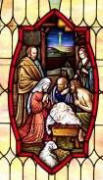
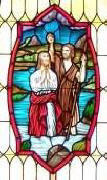
The church had stained glass windows installed in the 1950s as memorials to various parishioners and clergy. The Stained Glass Windows of Christ Episcopal Church depict the life of Christ as told in the Gospels – from His birth in a manger in Bethlehem, His baptism in the river Jordon by John, His ministry that included teaching the children and the masses, to the last supper with His disciples before His arrest and conviction, crucifixion, resurrection, and ascension. The windows are in chronological order starting from the right (facing the altar) and wrapping around the church to the left.


In 1966, Christ Church called The Rev. Claude A. Collins as rector. During his 20 year ministry, the parish once again became self supporting. An outdoor “children’s chapel” was constructed to the west of the church and in 1978, a pair of brick entrances was constructed at the highway entrance to the church. The Rev. Collins retired in 1986.
Since 1986, Christ Episcopal Church has continued having worship services every Sunday, though it did not experience any notable growth. Three full time rectors have served Christ Church since Fr. Claude’s long tenure. Between 1986 and 1996, Christ Church was served by the Rev. Warren Soule, the Rev. Diane Corlett, and the Rev. William Skidmore.
After 1996, the parish was served by three rectors/vicars that were part time, and then afterward sustained by several devoted supply clergy of the diocese who led services each week.
In 2005, Christ Church embarked on a visioning process to set mission goals for the new millennium. Part of that process revealed a need for full time clergy support and a re-awakening to the vitality and momentum that was starting to build on this side of Rowan County. The vestry and search committee took care to measure and plan for the future of Christ Church.
The Rectors & Vicars of Christ Episcopal Church; Rowan County, NC
| I. The Rev. Robert Johnstone Miller | 1786-1825 |
| II. The Rev. Thomas Wright | 1825-1832 |
| III. The Rev. John Morgan | 1833-1836 |
| IV. The Rev. Thomas F. Davis | 1836-1846 |
| V. The Rev. Charles Bruce Walker | 1846 |
| VI. The Rev. John Haywood Parker | 1846-1848 |
| VII. The Rev. Oliver Sherman Prescott | 1848-1850 |
| VIII. The Rev. James G. Jacocks | 1850-1855 |
| IX. The Rev. George Badger Wetmore | 1857-1888 |
| X. The Rev. Edward P. Green | 1889-1890 |
| XI. The Rev. Francis J. Murdoch | 1890-1892 |
| XII. The Rev. Robert B. Owens | 1892-1893 |
| XIII. The Rev. Sidney S. Bost | 1893-1898 |
| XIV. The Rev. Hatch Deut | 1899 |
| XV. The Rev. Thomas Lee Trott | 1899-1902 |
| XVI. The Rev. John Linker Saunders | 1902-1903 |
| XVII. The Rev. Royal G. Shannonhouse | 1903-1904 |
| XVIII. The Rev. Locke Winfield Blackwelder | 1904-1905 |
| XIX. The Rev. Simeon Jeremiah Michael Brown | 1906-1920 |
| XX. The Rev. Joseph Wilson | 1920-1924 |
| XXI. The Rev. William Hill Hardin | 1924-1934 |
| XXII. The Rev. Reuben Meredith | 1934-1940 |
| XXIII. The Rev. Jadi L. Martin | 1941-1959 |
| XXIV. The Rev. William J. Moll, Jr. | 1959-1962 |
| XXV. The Rev. Donald Wallace Frazier | 1963-1966 |
| XXVI. The Rev. Claude Alvin Collins | 1966-1985 |
| XXVII. The Rev. Warren John Albert Soule | 1986-1988 |
| XXVIII. The Rev. Diane Bishop Corlett | 1989-1992 |
| XXIX. The Rev. William Magill Skidmore | 1993-1996 |
| XXX. The Rev. Glen Gould | 1998-1999 |
| XXXI. The Rev. Harold Elsner | 2000-2003 |
| XXXII. The Rev. Michael Moulden | 2004-2005 |
| XXXIII. The Rev. Kenneth Hope Saunders III | 2007-2011 |
| XXXIV. The Rev. Sarah Blaies | 2012-Present |
 Christ Episcopal Church